
what to do in digital stew
on the phenomenology of social media

We are always in soup.
To be alive is to wade through a sensory totality of sights, sounds, thoughts, and fleeting emotional states. This sheer, all-encompassing everythingness is incomprehensible in its entirety, but we can attempt to gesture at individual ingredients of our soup, even if we fail to truly capture the whole.
Over the past year, I’ve slowly been trying to answer the question of what it means to experience social media, and I’ve found this to be a soup in its own right. The phenomenon can only be pointed at from all sides, with each angle sketching in more of the picture.
I’ve written essays about how social media can be understood as a physical space, a religious ritual, and a form of subjugation; I’ve explained how we hold implicit assumptions about “content” and “platforms” and the “For You Page.” I stand by all of these observations, but each framework is reductive when taken by itself. Instead, you must understand these as ingredients in the everything-soup of scrolling.
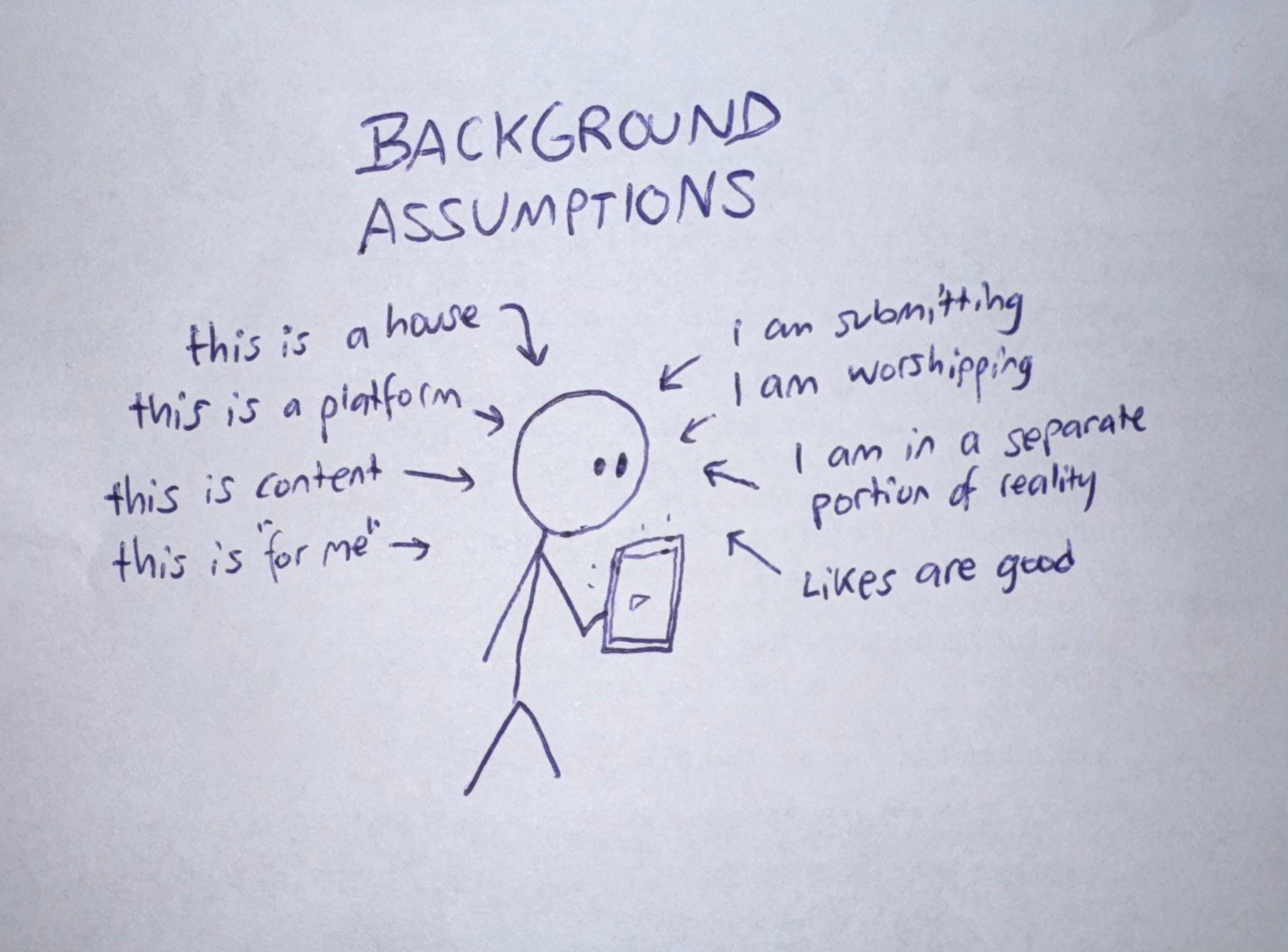
We begin with the phone as a physical object, which we already encounter in so many dimensions: as a source of comfort and security, an object of veneration, a black mirror reflecting you back to yourself. Everything that happens on social media is preceded by the fact that it first happens on your phone—this individual, intimate extension of yourself.
Then there’s the phone interface, which has conditioned you to think and act a certain way. It has taught us to summon entire worlds with the graze of a finger, melding your consciousness into the delicate haptic experience of touching a screen. Each world holds a unique oneiric potential, captivating our imagination and expectations before we even open an app.
The app itself is pre-defined by what Aidan Walker calls “platform presence,” and I call another layer of soup. Just as your home screen shapes your ambient understanding of what’s happening, so does the “always-already thereness” of TikTok or YouTube. These have their own spatiality and imaginative possibilities. Likes are displayed on the side of a video, telling us that “this is good” by signaling collective approval. The comments section is a place of both retreat and consensus, bathing you in effervescent refuge from the video itself.
As you gaze through the scrim, you project your internalized ideas that you are watching “content” “on” a “platform.” The very peripherality of the user interface haunts your interpretation of what’s happening—all before you get to the video itself. Here you devote your sustained attention, encountering yet another thick stew of sensation, subtly conditioned by everything: who you are as a person, the conversations you’ve previously had about social media, your pre-formed opinions about individual influencers, and so on.
Each experiential layer, between the phone and the “content,” is like a nesting doll, recursively casting itself onto the next layer. The medium of the phone has a sense of spatiality, agency, and liminality that gets echoed in its operating system, which gets echoed in the app interface, which affects how you look at the smallest matryoshka. Meanwhile, each embedded layer also resonates upward. The fact that you use your phone to look at TikTok helps define what you think a “phone” is.
The first step to understanding soup is realizing that everything is completely mixed together. This is a blessing and a curse. You can’t take any ingredients out, but you can put new ingredients in. The more we challenge what we see and change our background assumptions, the more we can shape our perpetual stew into something we enjoy.
If you missed it, make sure to check out my new TED talk below:
Please also consider buying my book here.
No matter whether it's soup or slop, it sure is slushy all the way down.
I'm 67 — decrepit, unwell, on the final straight.
Most of my contemporaries have one thing in common. We know we don't have long for this world. We should like to make contact once more with the lost friends and loves of our long-ago youth.
I've been using social media to seek out the girls and boys, now old women and men, who were my playmates from forty to sixty-five years ago. Soup? More like thin gruel for the now toothless.