
slop realism

We are in a culture of optimization, which means we are in a culture of slop.
The core paradox: as soon as something is identified as “good,” it becomes optimizable. As soon as something is optimizable, it is scaled and mass-produced. Eventually, unavoidably, the concept is devalued and we get slop.
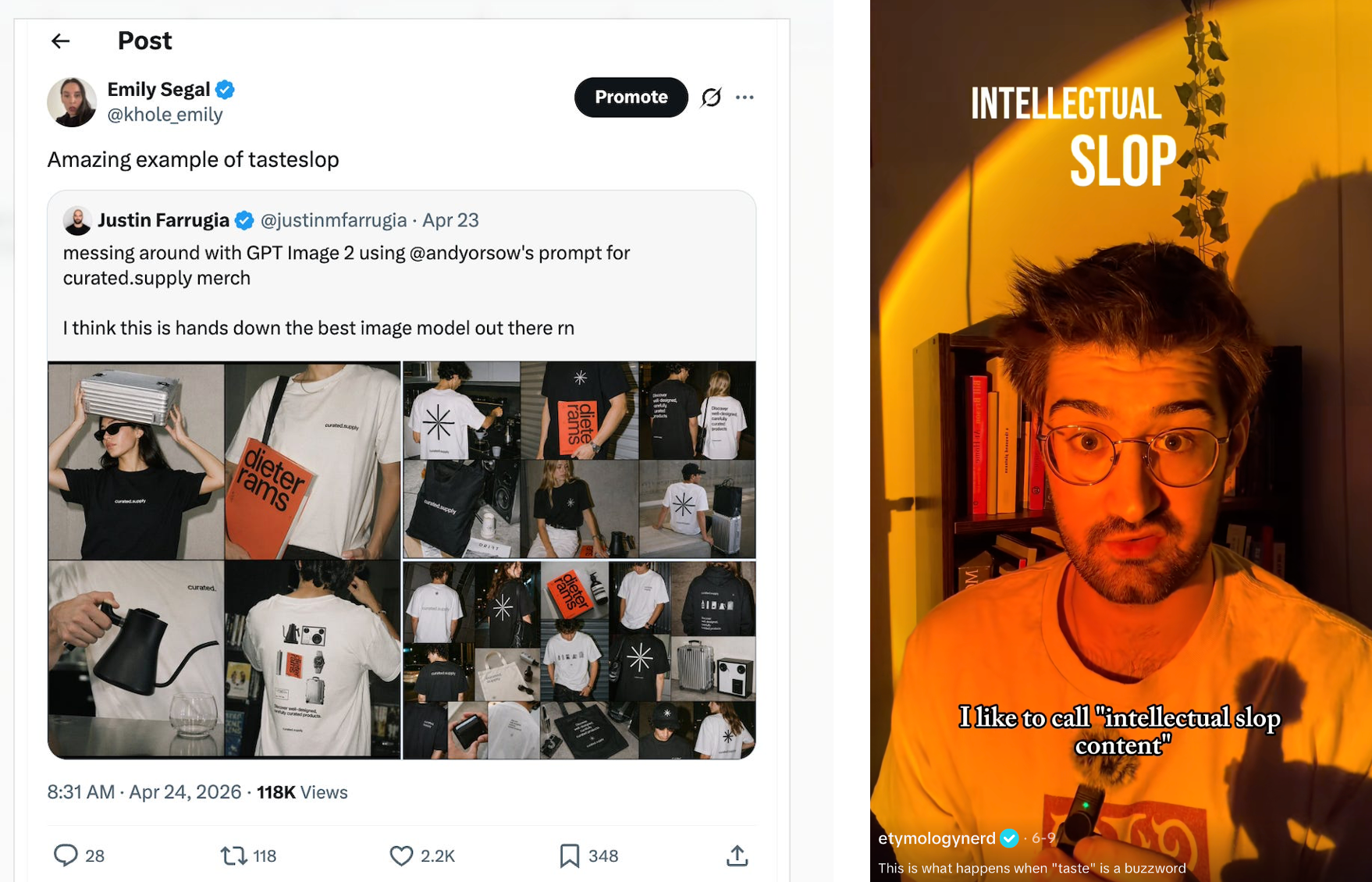
“Taste” was never the solution, because “taste” is identifiable. Shortly after the internet latched onto Pierre Bourdieu, every influencer immediately began replicating the same pretentious semiotics; every Brooklyn cafe adopted the same minimalist aesthetic; and every brand moodboard incorporated the same modernist tasteslop.
Then we pivoted to “whimsy,” supposedly the unpredictable antidote to a predictable algorithm—and yet thousands of social media gurus are now posting guides on how to be more whimsical. The term has been aestheticized into polka-dot goblincore frolicking oblivion, completely debasing the original notion of “following your individual whims.”
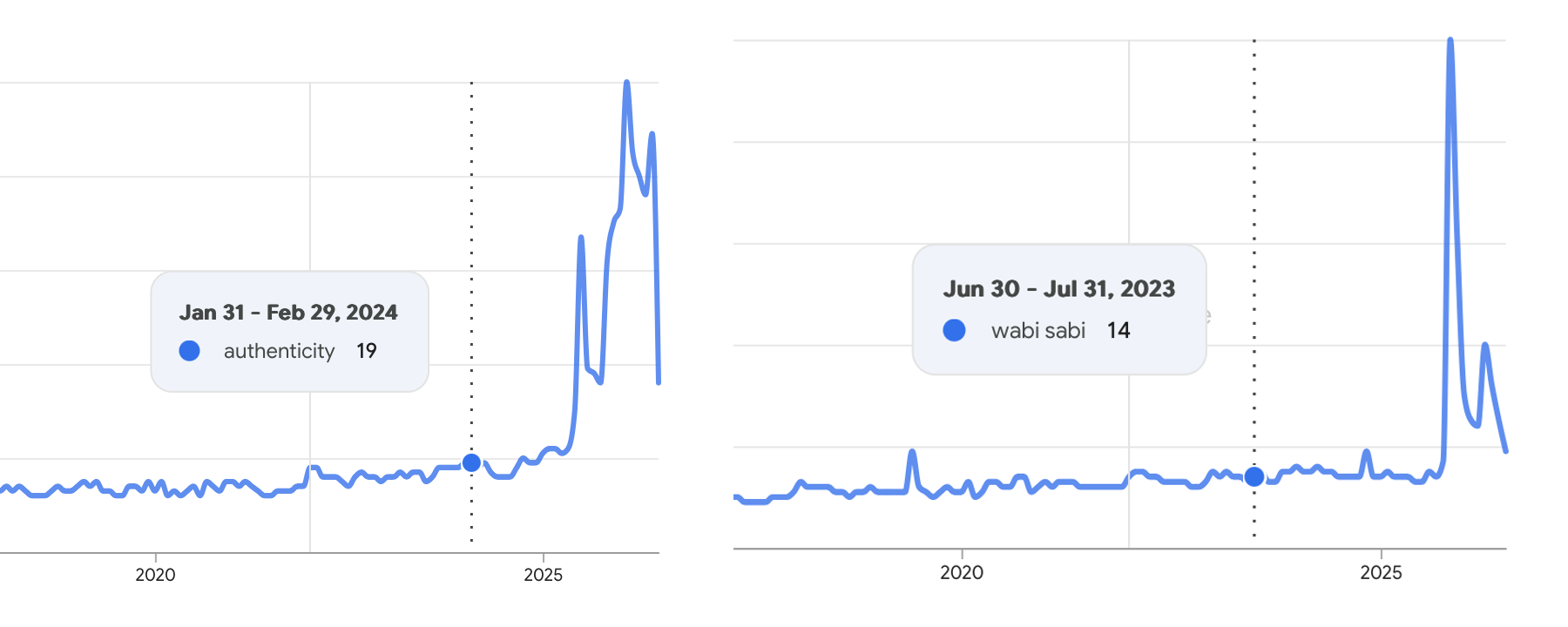
Along with whimsy-slop, we’ve seen the rise and fall of authenticity and wabi-sabi—both intended as a return to unmediated imperfection, both hoisted on their own petards. “Authenticity” is now something you can perform, while “imperfection” is now something to perfect.
I’ve previously written about how internet aesthetics like corecore and hopelesscore emerged as ways of critiquing the algorithm, but were quickly subsumed by the engagement treadmill. The same is true for any brainrot genre—each meme emerges because it speaks to a cultural frustration, but is inevitably flooded by digital carpetbaggers trying to score easy “likes” and “views.”
If “slop” is the precipitate of optimization, it is easier to imagine the end of the world than the end of slop. Suppose you want to make your interests undiscoverable, so you prioritize illegibility. Now you’ve incentivized me to produce ambiguityslop (which is arguably why the word “vibe” became a buzzword last year). Or perhaps you want to gatekeep your interests—now we’re back at tasteslop.
Slop realism is the understanding that, like capitalism, “slop” is a Moloch—a structure we are forced to participate in, which worsens society. While there is still something to be said for actual authenticity, whimsy, and taste, even your personal preferences are being measured and targeted in a way that will only generate more slop with time.
This outlook seems bleak, and it is easy to surrender to the metrics, but I see it as an imperative to shine. In the words of Mark Fisher,
“The very oppressive pervasiveness of capitalist realism means that even glimmers of alternative political and economic possibilities can have a disproportionately large effect. The tiniest event can tear a hole in the grey curtain of reaction which has marked the horizons of possibility.”
I see these glimmers in our language, our memes, and our tenacious insistence on rejecting the world we don’t want to live in. I’m also drawn to the footnote of Allen Ginsberg’s poem Howl, which similarly refuses to give in to Moloch:
Everything is holy! Everybody’s holy! Everywhere is holy! Everyday is in eternity! Everyman’s an angel!
“Slop” happens when we forget to treat everything as holy, a Germanic word meaning “whole.” Optimization focuses on the legible, the measurable, the specific—and, in doing so, it hollows us out, failing to account for our indescribable totality. The only solution is to make everything important, all at once, and now your metrics are worthless.
This dovetails with something I've been thinking about: if optimisation turns everything into slop, it may eventually turn the word "slop" into slop, too. The term increasingly feels less like a description and more like a thought-terminating critique, especially once it becomes a suffix that can be attached to almost anything. Wrote a short piece on that idea here: https://twohundredths.substack.com/p/like-mid-before-it-slop-has-become?r=4azpw5&utm_campaign=post-expanded-share&utm_medium=post%20viewer
Capitalist realism suggests that capitalism has become so dominant it has become impossible to even imagine alternate societal structures.
I don't think we're at slop realism by that same metric (yet).
For everyone I see chasing "authenticity" or "whimsy" or whatever else the sloporithm rewards, I know at least as many doing their own thing (in effect being very "authentic" or "whimsical" without even considering those terms).
I'm not sure if this is going further downhill or just making us more polarised into extremely online vs extremely offline.