
feeling without thinking

There are two ways you can look at media: immerse yourself, or detach yourself.
As you’re reading this, you’re immersed. You have to be. Otherwise you’d be looking at an unintelligible jumble of letters, contemplating hieroglyphic forms without meaning.
Nobody is forcing you to immerse right now. You made a conscious decision to focus your attention, and you can decide to defocus at any time. This freedom gives you the ability to pause and evaluate text rationally.
Social media does not have that freedom. There is a constant stimulus pulling you back in, recapturing your attention as soon as it begins to defocus. You are trapped in the state of immersion—not a good state, like being “in the zone” or in a state of “flow,” but in a passive state where you lose mindful awareness of your environment.
Again, this kind of immersion is actually necessary to experience media, but detachment is equally important. That’s how you learn; that’s how you consciously evaluate the medium that’s affecting you.
When I look at art, for example, I find myself constantly cycling between feeling and thinking. I usually start in a state of pre-linguistic immersion. I experience the sublime beauty of the painting. Sometimes I cry. Then I consider what made me cry or what the painting is telling me. Then I feel again. I come away understanding more about art and more about myself.
All media is in this cycle of feeling and thinking, but sometimes the cycle spins faster or slower.
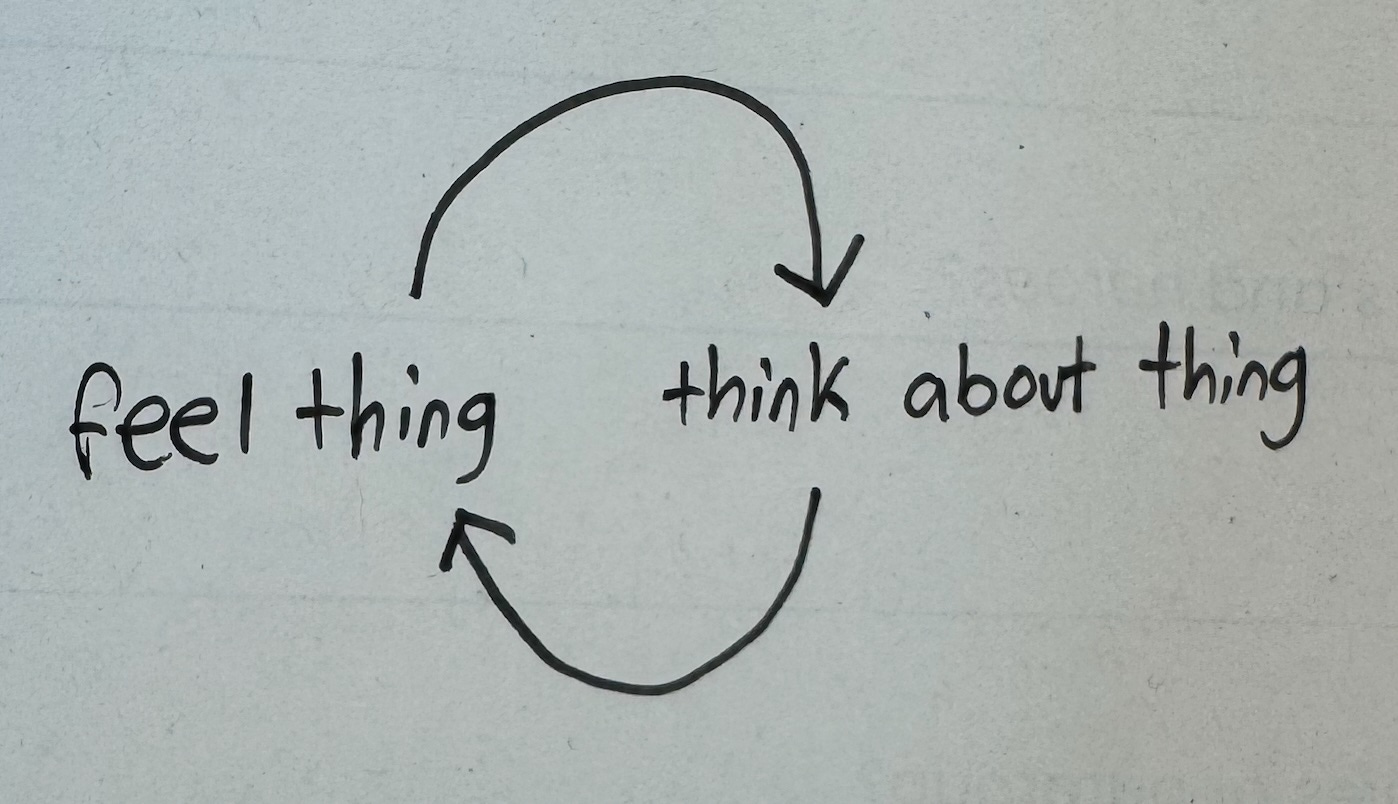
When you read a book or experience art, for example, you typically engage one sense at a time. You see, but you don’t hear. This makes a big difference: it is easier to break immersion without a sound also pulling you back in.
Nor do books move. The motion of a movie keeps your eyes involved, tracking a constantly engaging stimulus. There are a few moments of detached reflection, but they come at the end, or at slow moments, or if you pause the movie to react to something that just happened. Because there are fewer moments to think, the cycle spins slower—but it’s still spinning.
On social media, we are trapped “feeling” without “thinking.” The medium is optimized for retention—a fancy code word for the state of passive immersion—which means it’s actively designed against deliberate detachment. If your attention starts to wander, a new sound or moving thing pulls you back in. Your media literacy cycle is stuck in place.
And while feeling is important, so is detaching. It’s how you become aware of what you’re consuming. I can’t count all the times I’ve heard someone reference a video in conversation, only for the other person to say “I think I’ve seen that” or “I feel like I’ve seen that somewhere.” Not that they’ve seen it—that they think they’ve seen it. Meanwhile, I know when I’ve read a book and I know which paintings I’ve cried in front of. That’s because I took the time to both feel and understand those forms of media.
When we are isolated in the state of immersion, everything becomes a part of the endless scroll, an ambient stream of consciousness instead of something discrete and real. Truth becomes less important than what you feel like the truth is, and our feelings are conditioned by what we see disproportionately represented on our feeds.
It’s funny that I can think about this from my perspective as a creator. The big buzzword in influencer marketing for the past decade has been “authenticity.” To connect with your audience or advertise a product you need authenticity—but that only means “the appearance of truth.” We don’t talk about facticity—actual truth—merely the semblance of it.
This is how misinformation spreads online. If an idea makes you feel something, and you stop to question its facticity, you can pretty easily find out whether the idea is made up. But when you live in the state of feeling authenticity over discerning facticity, it is easier to believe lies, and even help spread them.
The obvious solution is to touch grass. If we deliberately engage with unquestionably real things, we will have a better sense of our own reality. From there, build up to simpler forms of media, where we can engage with the ability to detach.
I don’t think we should abandon social media entirely. I think it is dangerous to ignore its current influence over our society, and it is possible to subversively engage with it—if we collectively rebuild our attentional toolkits. Over time, we can piece together a more honest internet, with platform regulations supporting intentional communication. In the meantime, stay real.
This is why I always have the sound off on my phone. I normally dislike subtitles, but it’s perfect for social media as it allows me to maintain the detachment you describe.
If videos automatically paused for you to think (like Dora, except you have to click resume), would you consider that to reintroduce the thinking/feeling loop?
An example of this could be story driven video games - there are pauses, and the world isn't constantly moving.
(fwiw, this doesn't feel like it fits the same bill as reading, bc automatically pausing means you're not in control - you're relegating when to think, to when the creator decided to auto pause)