
slop ecology
and literature review

When a heroin addict unknowingly overdoses on fentanyl, who do you blame?
One school of thought blames the user. They made an irresponsible choice, and this was the consequence of their action—but they may not have had full control over their decisions, and they certainly didn’t have full awareness of what they were consuming.
Many people instead blame the drug dealer who cut the heroin. They’re the culprit, they committed the horrible act—but I’m sure the dealer would prefer their customer to stay alive. If the cost of heroin were the same as the cost of fentanyl, they’d rather distribute the safer product their customer actually wanted.
Maybe the problem is the fentanyl itself: the fact that there is a highly dangerous, cheaper alternative to heroin. The opioid literally killed the user, and its lower costs incentivized the dealer to act recklessly. And yet to focus entirely on fentanyl is to ignore each person’s agency in the situation, and the mechanisms that distributed the drug in the first place.
Perhaps the government should have intervened, perhaps the laboratory should never have synthesized a dangerous substance—or perhaps we just want a simple story. The less comfortable truth is that “blame” is distributed everywhere from the start of the process to its finish. A drug overdose, however terrible, cannot be chalked up to a single neat explanation, but to an ecosystem of actions and incentives spanning the entire drug trade.
Although fentanyl is an extreme example, the underlying framework of blame is the same for “slop” on social media—and I promise this analogy will make more sense in a moment. When the concept was first formulated on 4chan in the late 2010s, it began as a direct outgrowth of “goyslop,” the antisemitic conspiracy theory that a secret cabal of Jewish elites is feeding the masses cheap, unhealthy food.
In a new paper, the internet archaeologist Sophie Publig argues that the original sense of the word is critical to understanding its modern usage. Both the conspiracy theory and the actual reality of “AI slop” rely on 1) a hidden intentional agent; 2) a degraded substance distributed to a passive mass; and 3) a knowing critic who is able to see through it all.
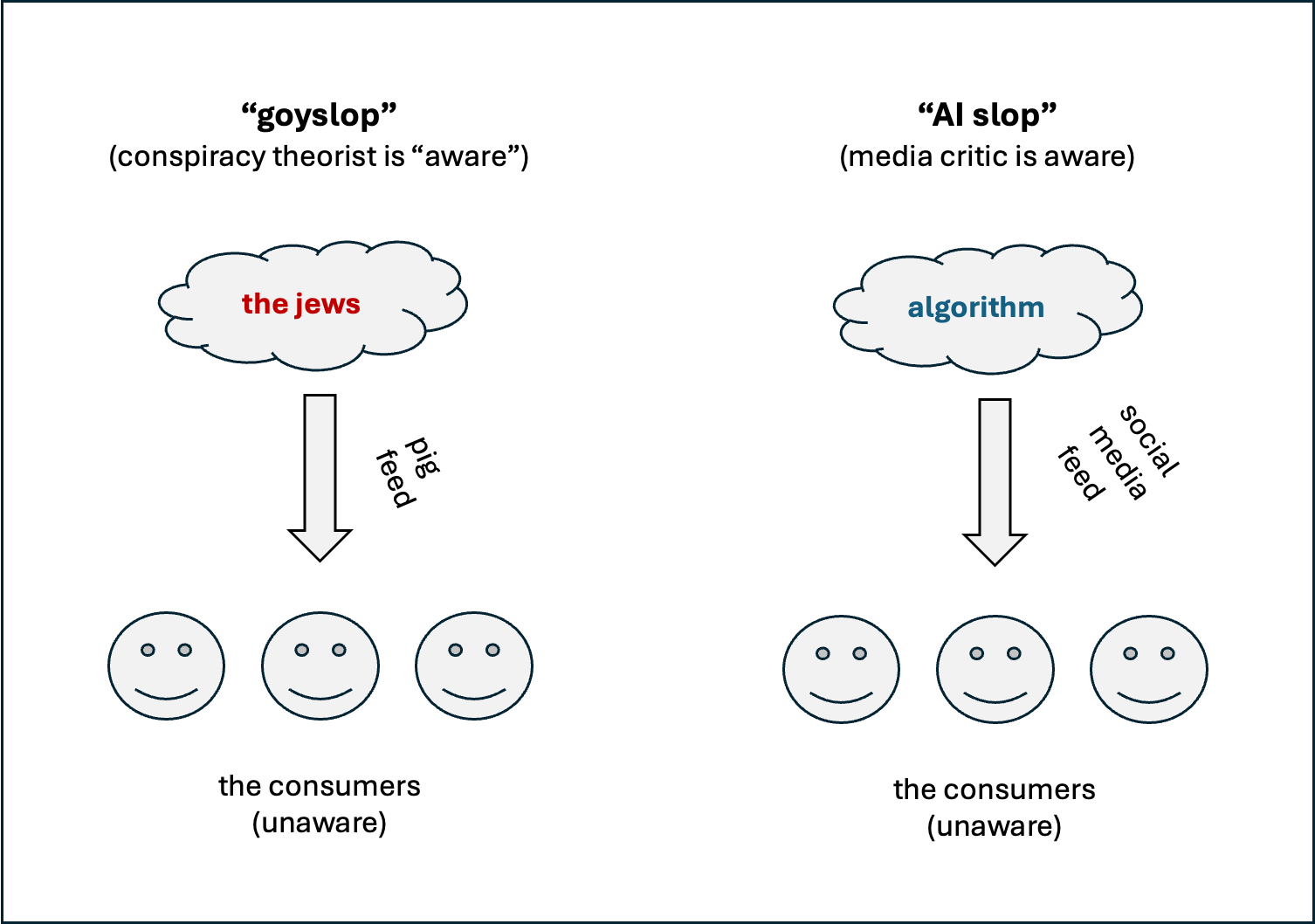
Publig mirrors Mike Pepi’s brilliant theory of slop materialism, which argues that instead of asking “what is slop?” we should rather be asking “when do we slop?” Unfortunately, Pepi falls into the classic trap of claiming that “slop” is exclusive to AI, which is kind of like saying drug overdoses are exclusive to fentanyl. In truth, both exacerbate an existing problem: that there are misaligned actors structurally incentivized to create low-quality content for their unsuspecting consumers.
Cultural critics like Sean Monahan and Ruby Justice Thelot make excellent arguments that “slop” has always existed. Hallmark movies, penny dreadfuls, and pulp magazines were all “slop” of their time, in that they prioritized profit over meaningful communication. Under this framing, in the words of Max Read, “slop” is something “fully optimized to its domain to the point of texturelessness or characterlessness.” I’ve also expressed a similar definition in my earlier Notes on Slop here.
The issue with regarding slop as a noun, rather than a verb, is that it decenters the productive process. Once we know we’re consuming a degraded substance, the blame rests either on the creator for producing it, or the user for participating in it.
“Slop” isn’t really your fault if you’re addicted to your phone. It’s not really the fault of the Lithuanian 24-year-old making racist videos that are good for engagement. It’s not even quite the platform’s fault. “Slop” is instead an ecology, including everything from the annotation workers in Nigeria to the data centers on indigenous land to the way you scroll on social media. Nobody is to blame, and everybody is to blame.
After reading almost every analysis I could find on the matter, my favorite opinion comes from the Northwestern University Professor Jessica Hullman:
Slop is not merely a genre of media, it is an attitude of production, a cynical operating posture… it is an ethos of resigned instrumentality that disgusts us with its intentional satisficing and lack of effort the way kitsch disgusted some art critics, a refusal of responsibility to authenticity, situatedness, and the risks associated with individualistic expression. A practical nihilism that threatens to engulf our own more sparse yet genuine attempts at production. From this perspective, the act of denial makes slop more like a spiritual threat than a type of content.
“Slop” is a spiritual threat spanning from Hallmark movies to the opioid crisis. While these problems have immensely different severity, the ecology is the same. All the incentives are telling us to participate in a corrupt system, and we slop when we succumb to the devil on our shoulder. The only way to reject it is to reject nihilism at every level of participation:
change the incentives for producing and consuming slop
change the distribution structure
produce content intentionally
consume content intentionally
be mindful of the entire ecology, rather than a single symptom
If you want to combat a spiritual threat, make everything sacred. If slop is optimized in a way that feels meaningless, we have to reconsider our optimization and make the world feel meaningful. This is a battle for the human soul.
TONIGHT (June 30), I am hosting a teach-in for the New York City Neo-Luddite “Summer of Ludd.” Come to the Pennington Friends House at 5:15 pm.
JULY 9 at 7:30 pm: I will be in conversation with Daniel Keller, coiner of the word “sloptimist,” at the TIAT gallery in San Francisco. Get your tickets here.
Does the advice offered so widely on Substack to publish every week help feed the culture of slop? If so (I think it does), doesn’t this suggest that the writer who wants to resist slop should only publish when they feel they have something worthy (sacred?) to offer?
Slop, in all its various forms is a collective action problem. As you note, the incentives all push towards the creation of slop. One of the reasons it’s so pervasive is that costs to create slop are very low so it doesn’t need much incentive to make it worth it.
The individual can resist slop through your points 3 and 4, but I would also add that one can consume high quality media as an antidote. I have been reading what I think of as “real books” and recently finished “A Canticle for Leibowitz” and am making my way through Kurt Vonnegut’s catalogue. I have noticed that my own writing has improved from reading high quality prose as it resets my brain and flushes out crummy AI writing patterns that are completely hackneyed.