
you also need the stuffed monkey

In 1957, the American psychologist Harry Harlow conducted an infamous experiment where baby rhesus monkeys were given the choice between two different “mothers”: one made of wire and one made of cloth. The wire mother held a bottle of food, while the cloth mother held nothing, and yet the monkeys overwhelmingly chose the cloth mother every time.
I’ve been thinking a lot about the Harlow monkey experiment as the internet obsesses over Punch-kun, a socially anxious Japanese macaque that returns to his stuffed monkey whenever he struggles to interact with the other macaques.
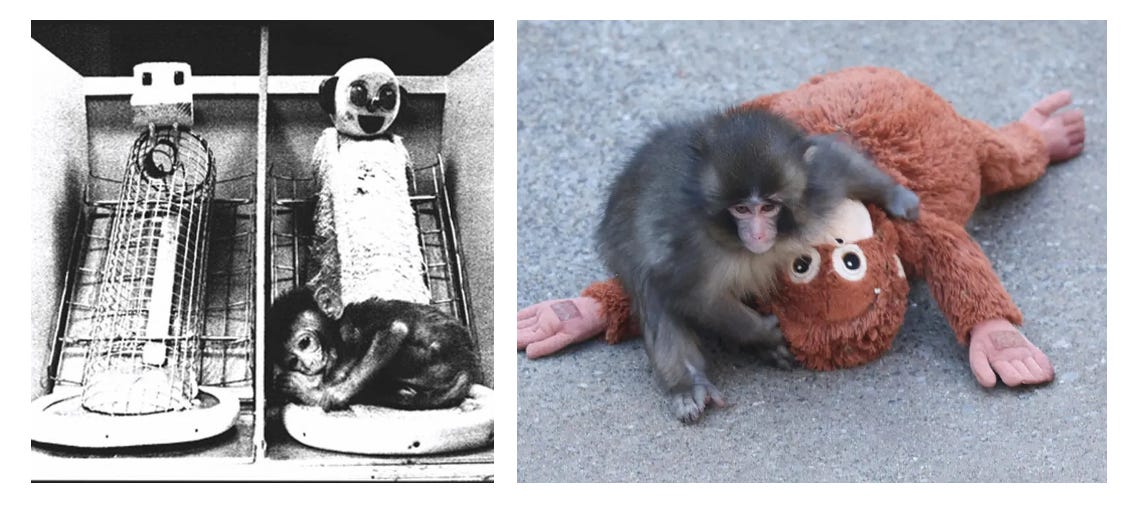
It’s easy to see why Punch is captivating people’s hearts. We’re literally monkeys ourselves. Everybody can project their own stories onto him; all of us have sought out comfort in difficult situations.
However, the Harlow experiment is a warning about how our monkey instincts can be used against us. When I look at the photograph of the wire and cloth mothers, I see the physical and digital worlds we’re moving toward. One is stripped bare of everything but the basic resources for survival, while the other is an ersatz source of comfort.
The cloth mother is an AI chatbot or a social media influencer. She looks real enough to comfort your monkey brain into feeling a minimum amount of social connection. We turn to her when we can’t find any actual monkeys.
The wire mother is the self-checkout lane in a grocery store, or the sleek grey fast casual restaurant. You get what you want, without interacting with anyone, and then the space practically begs you to leave.
The more our physical spaces are optimized and transactionalized, the less the real world will look like the real world. At the same time, the better our technology gets, the more our digital world will appear like it’s the real thing. We’ll increasingly find ourselves clinging to it in anthropomorphic consolation while everything else withers to wire.
Following the surrogate mother experiment, most of Harlow’s monkeys turned out severely socially impaired, struggling to bond with other monkeys. I worry the same will be true for us, because artificial connection can never replace actual connection.
Punch, meanwhile, symbolizes how things could still go right. His stuffed animal helps him develop social skills and learn to interact with the other monkeys. The zoo is carefully designed for him to thrive; resources aren’t separated from community.
It’s a basic human instinct to seek the cloth mother. We need to feel connected to people and things. Arguably, this is what makes us human in the first place. But the things don’t have to come at the expense of the people. It’s possible to develop both our real world and our technology in a way that cultivates warmth and meaning.
This starts with carefully building our environments to augment the best in ourselves. We can’t focus on just the online, or even just the offline. Society now depends on both, and neglecting either would lead us into Harlow’s dystopia.
Cute animal videos will always go viral, but I’m sure there’s a reason Punch resonated so much in this current moment. He’s a lonely monkey, and we’re in the middle of a loneliness epidemic. We’re all drawn to the “stuffed animals” in our own lives, but we should recognize that these are means to an end, rather than the end itself. Instead, we must use our tools to build community where we can, understanding that we are monkeys as well.
Upcoming speaking events:
This Wednesday 2/25 at CU Boulder - details here
This Thursday 2/26 at UC Berkeley - details here. Event is currently full but they might move to a bigger room
March 13 at SXSW, Austin - details here
As always, if you liked this essay, please consider buying my book Algospeak! Thanks for your support :)
My anthropologist wife wants me to point out we're not literally monkeys. We're apes.
Loved this