
the monsters hiding in your algorithm

Did you know Kehlani released a fifth album? Did you know Abu Dhabi is building a new version of the Las Vegas Sphere? Did you know GTA 6 is coming out in November? Did you know Calvin Klein just launched their Jung Kook Collection?
TikTok’s “trending searches” often read like an advertisement, because that’s exactly what they are. These are the things you’re supposed to look up, the things that bring in the most revenue. The search results are reliably clean, polished videos, showing exactly the content you expected to see.
As soon as you stray from the beaten path, however, you begin to encounter demons. You were never supposed to search “agd74864skgmkvc.” The old rules don’t apply here. You are in the TikTok Farlands, where horrible entities lurk in the shadows.
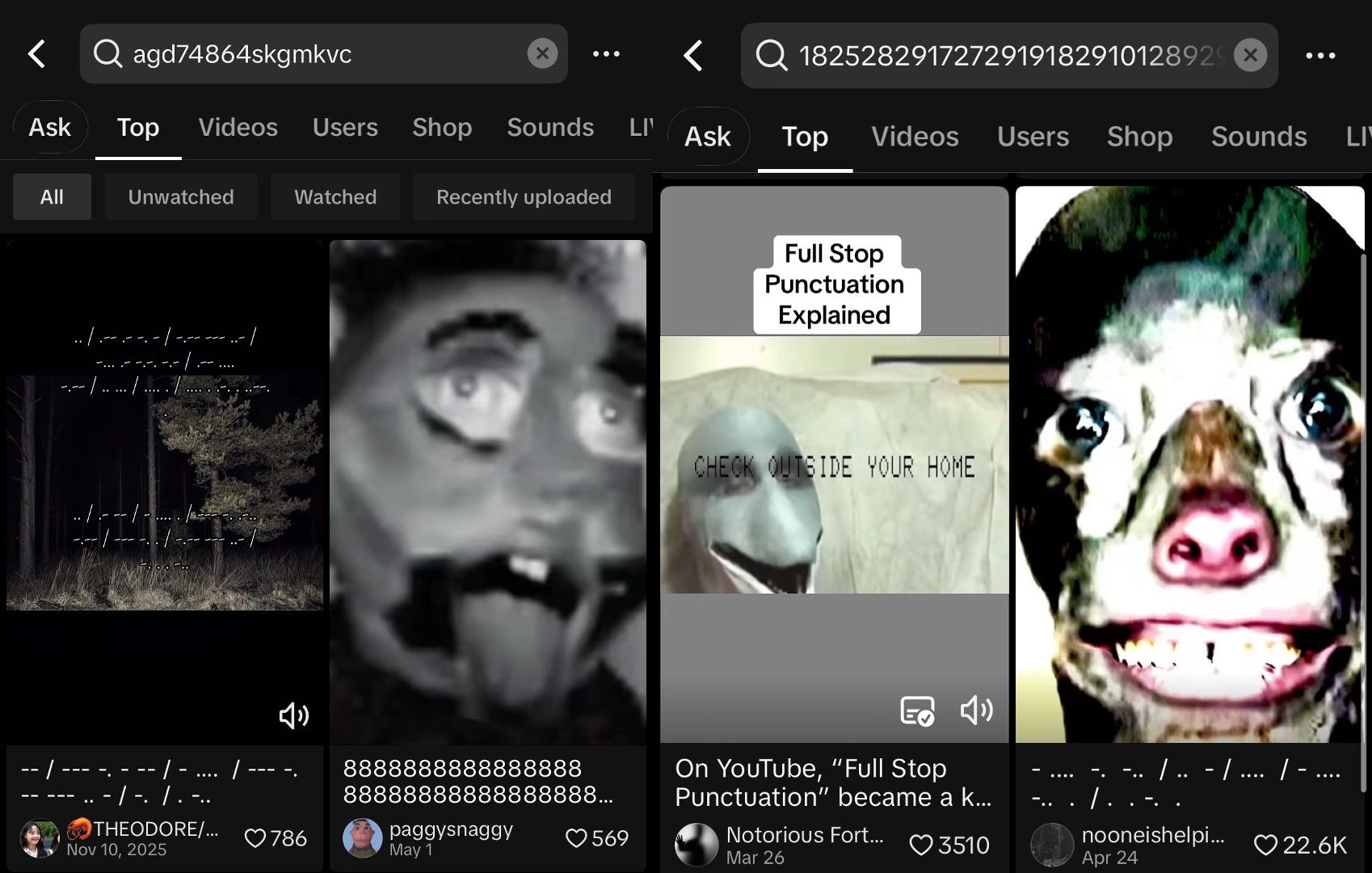
The Farlands are no different than the monster under your childhood bed, or a medieval cartographer writing hic sunt dracones at the edge of a map. Whenever we exceed our ability to categorize, the supernatural takes over. ChatGPT can’t stop talking about goblins, and your algorithm can’t stop spawning Lovecraftian abominations.
It certainly feels like we’ve come a long way from drawing sea dragons in the Atlantic Ocean. We’ve mapped the world many times over, and our data centers hold ever more granular information about our identity and behavior. There should be no place for monsters in this realm of logic.
And yet, when you search “agd74864skgmkvc,” you are filled with the cosmic dread of knowing that there are a billion other results like this. For every video about a Kehlani album, there is an ocean of eldritch horrors beneath the surface. The rational world we interact with is a scrim over a frightening terra incognita, vaster than we can possibly imagine.
Across the world, various religions have built their cosmogonies around the concept of primordial chaos—a disordered abyss often containing incomprehensible creatures. Eventually, meaning and order emerge from confused nothingness, creating the world as we understand it today.
Our attempts to explain online anomalies—creepypastas and SCP wiki pages and jokes about the “TikTok Farlands”—are the same as the beasts of the Old Testament or the monsters of Greek mythology. They gesture at the unknowable, creeping past the borders of reason to become our shared reality.
Each online community has its own oral tradition, and each meme is like a monster emerging from the shared folklore. Nobody can really tell you where Big Chungus or Tung Tung Tung Sahur came from. Perhaps they are messengers from the void, reminding us of the internet’s cavernous liminality. How dare we try to categorize it into neat little Calvin Klein advertisements? Here there be dragons.
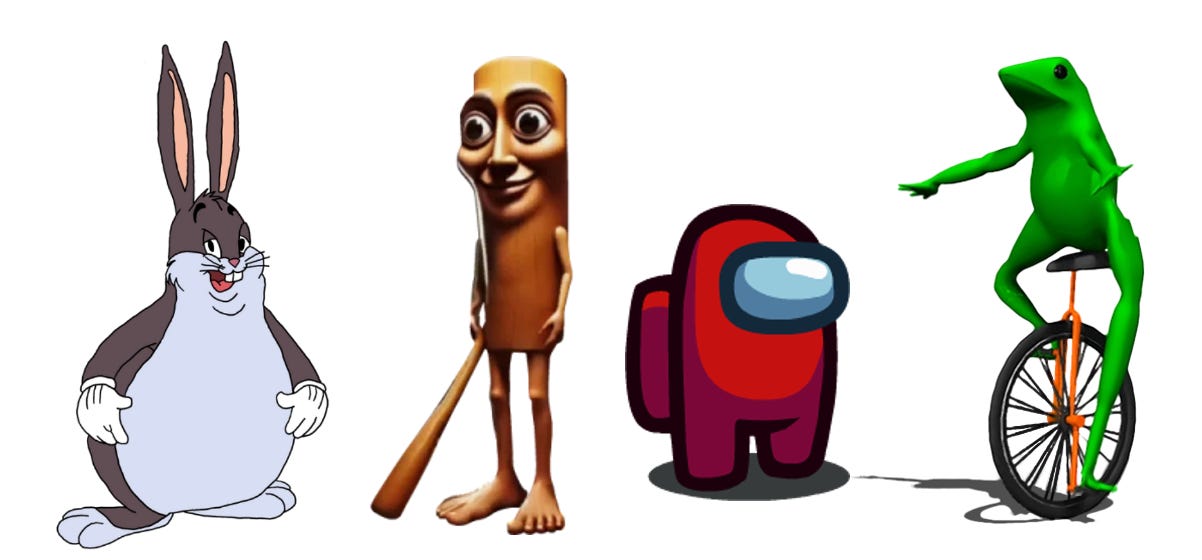
Yes, the memes are absurd, but the entire universe is absurd. This is the abyss gazing back at you, reminding you that you have no more inherent meaning than a cartoon character. Of course, you have the option to make your own—so do you really want to spend your time looking at any of this?
If you can’t make up your mind, there are probably many more memes hibernating under obscure search terms, waiting to be awoken from their slumber. When the time is right, the monsters will materialize.
Media I’m enjoying
This excellent account covering Chinese fashion aesthetics
If you missed it, please read Eliza McLamb’s investigation of “fake fans” in the music industry
Zarbworld’s map of internet aesthetics
I keep thinking about Moral Outrage Porn by Nguyen and Williams
What if dragon was just a word for danger is what I thought the moment I read hic sunt dracones. Off to the etymology chambers!
My physics BSc honours thesis was on uncertainty in classical mechanical systems, supervised by Michael Berry. It wasn't very good, I fear, barely scraped a pass. Mathematics is the language of physics and my maths wasn't good enough (still isn't).
I'm still interested in uncertainty in mechanical systems, which overlaps with but is distinct from chaos theory. In particular, I focus much of my energy on better definitions of SI physical quantities. For example, I've refined the SI definition of work, which as published continues to be inadequate, indeed inaccurate and abstruse to the point of being both incorrect and utterly useless, to be that 'Work is done by System A on System B that is equal and opposite to the work done by System B on System A when System A and System B act upon each other with equal and opposite forces such that a relative displacement of one or more parts of System A or System B takes place.'
I mention the above because while mathematics is the language of physics, internationally agreed definitions of SI physical quantities, eg the speed of light in vacuo, are formulated and published in British and/or US English, then translated into formal modern French, imposed upon the French Republic by the little Corsican whose family hailed from Genoa.
In other words, we use words in different spoken languages like English and French and conventional modern mathematical symbols in order to try to define as best we can the fundamental properties of the universe.
To unravel the mysteries of the universe, including its darkest corners, we need language — mathematics or otherwise. Moreover, in the process of unravelment, often we ourselves create knots of useless uncertainty — such as the currently useless conventional SI definition of work.