
our reality is glitching

I don’t usually notice that I’m wearing glasses. I don’t usually think about how I scroll on TikTok. Then my lens smudges, my screen buffers, and my world is interrupted.
Humans have an uncanny way of dissolving into their tools. When you swing a hammer, you don’t really conceive of it as separate from your body. It is instead an extension of your arm—what Heidegger calls ready-to-hand. Same with your smartphone. As you scroll, you melt into your screen.
Most of our lives are experienced in this state of flow. Sure, you can pause to theorize about hammers and smartphones, but you mostly just consider them when they stop working. You only perceive a table that wobbles; you only think about a television that fills with static.
We typically find these glitches annoying, but they’re incredibly powerful opportunities to understand our media. An eraser smear or ink blot disrupts the process of reading, reminding you about the writer on the other side.
The glitch calls attention to mediation. A lamp falls from the sky in The Truman Show; a cat reappears in The Matrix. Now we are aware that something exists between us and “true” reality. We can ask “why did this happen?” and the answer is often that things weren’t what they appeared to be.
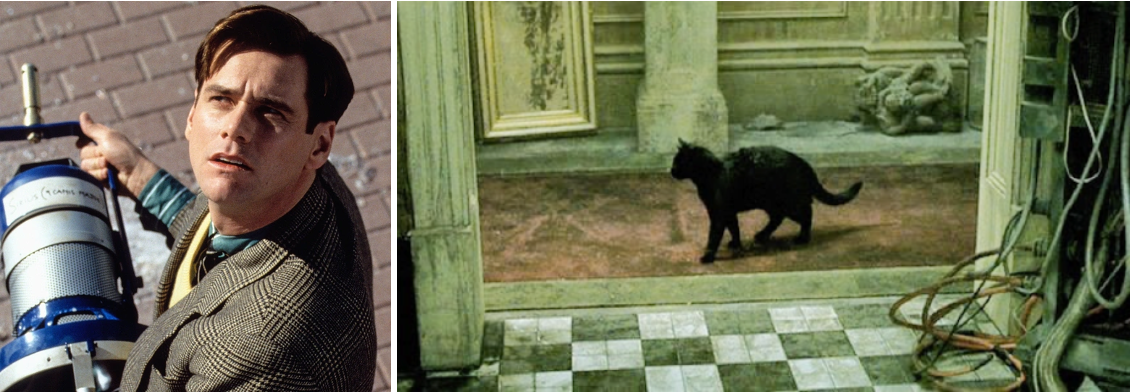
My glasses seem to show me the world until a smudge resurfaces how blurry my vision really is. The written word seems to contain information until a typo points out that no, it’s actually a flattened representation of someone else’s knowledge. And TikTok seems “real” until you are left staring at your reflection in a black mirror.
Each advancement in technology is supposed to remove glitches, making it easier for us to interface with media, but it always brings new glitches for us to notice. The interval of adoption is therefore incredibly important: we can either be lulled into a new form of sleepwalking or wake up from our previous stupor.
Right now, for example, our language is glitching. People are using the words “delve” and “intricate” more than they used to, because AI chatbots are biased toward certain vocabulary, and now they’re influencing the way we speak. Incel terms like “mogging” and “maxxing” have fully become mainstream, demonstrating how we’re being shaped by social media algorithms.
It’s easy to dislike these words, and you can “fix the problem” by refusing to say them. But wiping the smudge off your glasses doesn’t change how they influence your way of seeing. Language has always been socially constructed; it’s always evolved around the technology available to us.
Glitches are symptoms of a much deeper problem: that every medium is imperfect. We like to ignore this uncomfortable truth, so we settle into mindless routine. Then a technical interruption punctures our fog of expectation, and we get upset.
Meanwhile, the best things in life are all glitches:
the entire reason we like poetry
and humor and romance and art
is that there was a certain way things were supposed to unfold, but then something goes pleasantly wrong. We are pulled out of our trance and appreciate the flawed world around us.
Perhaps we should stop hating glitches and instead realize how they give us meaning, and the agency to change our surroundings. If a hammer is unbalanced, you can change the handle. If our language is shaped by incels, we can change the incentive structures online. Glitches show how reality is flexible, and that can go both ways.
Or we can keep stumbling around with our eyes closed, getting angry when things don't work perfectly. By refusing to sit with our tension, we’ll stay blindly irritated and accomplish nothing.
RECENT MEDIA
I just wrote this op-ed for the Washington Post, explaining how AI chatbots are biased toward Romance language etymologies.
I was interviewed for this NYT article on “mogging”
I also talked about incel language on NPR’s Code Switch
UPCOMING EVENTS
June 9: I’m recording a live podcast with CNN’s Clare Duffey at the Paley Center for Media. Tickets available here.
June 25-26: I’m talking about slop and reality at Vidcon in Anaheim, CA.
June 30: I’m hosting a teach-in for the NYC “Summer of Ludd” at the Penington Friends House at 5:15 pm.
In The Matrix, the deja Vu occurs "when they change something". I'm pleased by the symmetry in your conclusion, how the arrow of causation can point the opposite direction IRL - that glitches can prompt us to change something.
You have described one of the things I really hate about AI “enhanced” writing. Even when people use it merely to edit their works, the canned AI phrasing and structure sticks out like a sore thumb. It’s even worse when it’s used to write larger chunks, with metaphors that don’t make sense and words strung together that are devoid of actual meaning. There are a lot of posters on Substack that I’m tempted to subscribe to so I can harass them in the comments about their use of AI, but ultimately that would only provide them with an economic incentive to keep using it.